For years I paid CZK 2,400 a year (about €100) for Fakturoid, a Czech invoicing service. Building my own system used to mean 80 to 100 hours of work, and I always preferred to spend those on clients. In November 2026 I built it anyway: in three days, with AI agents and a few hours of my own attention. The same reasoning now applies to plenty of other tools. At IDEATECH we are replacing Jira and Toggl right now. When does it pay to replace SaaS with your own tool today, and what does that mean for its future?
Key takeaways:
- Without AI, saving CZK 2,400 a year against 80 to 100 hours of development would not pay back even in 30 years. With AI agents the system cost me a few hours of attention
- The best candidates for replacement are tools priced per user, with a simple domain, where you use a fraction of the features
- Time tracking and ticketing systems like Jira are good candidates today. At our company we are replacing them with our own tools for about ten people
- Booking, forms, simple CRM and automation are good candidates too. I would leave password managers, bulk e-mail, accounting and Slack alone
- Your own system means your own operations and maintenance. Not everyone wants to take that on to save a little money
- Simple SaaS tools will survive, but with lower margins. The ones that carry responsibility for the customer and have an API for agents will hold up. That is why I am building one at IdeaWood myself
Why didn't I build my own invoicing earlier?
Because the numbers didn't add up. Invoicing looks simple until you start listing what it has to do: number series, credit notes, PDFs, QR payments, e-mails, reminders, contacts from the Czech business register, backups. Without AI I would have spent 80 to 100 hours on it. Even at a modest CZK 1,000 an hour that is CZK 80,000, or 33 years of Fakturoid, and that is before maintenance. So I kept paying and didn't think about it.
What changed?
The way I write software. AI agents write most of the code these days, and I brief, review and test. I wrote the spec on the afternoon of November 11. The next day the first version was running, including payment matching against my Fio bank account, and on the third day it calculated income tax and social and health insurance. On the fourth day it learned to prepare the tax return and the insurance overviews. It cost me a few hours of my own attention at most. The rest of the time the agents worked and I did other things.
The system didn't start from scratch, though. I have established workflows for briefing agents and checking their output, and the agents could draw on my other projects on the same stack. Sign-in, deployment, backups and sending e-mail already work elsewhere, so they only had to be carried over. Someone just starting out with agents won't manage it in three days.
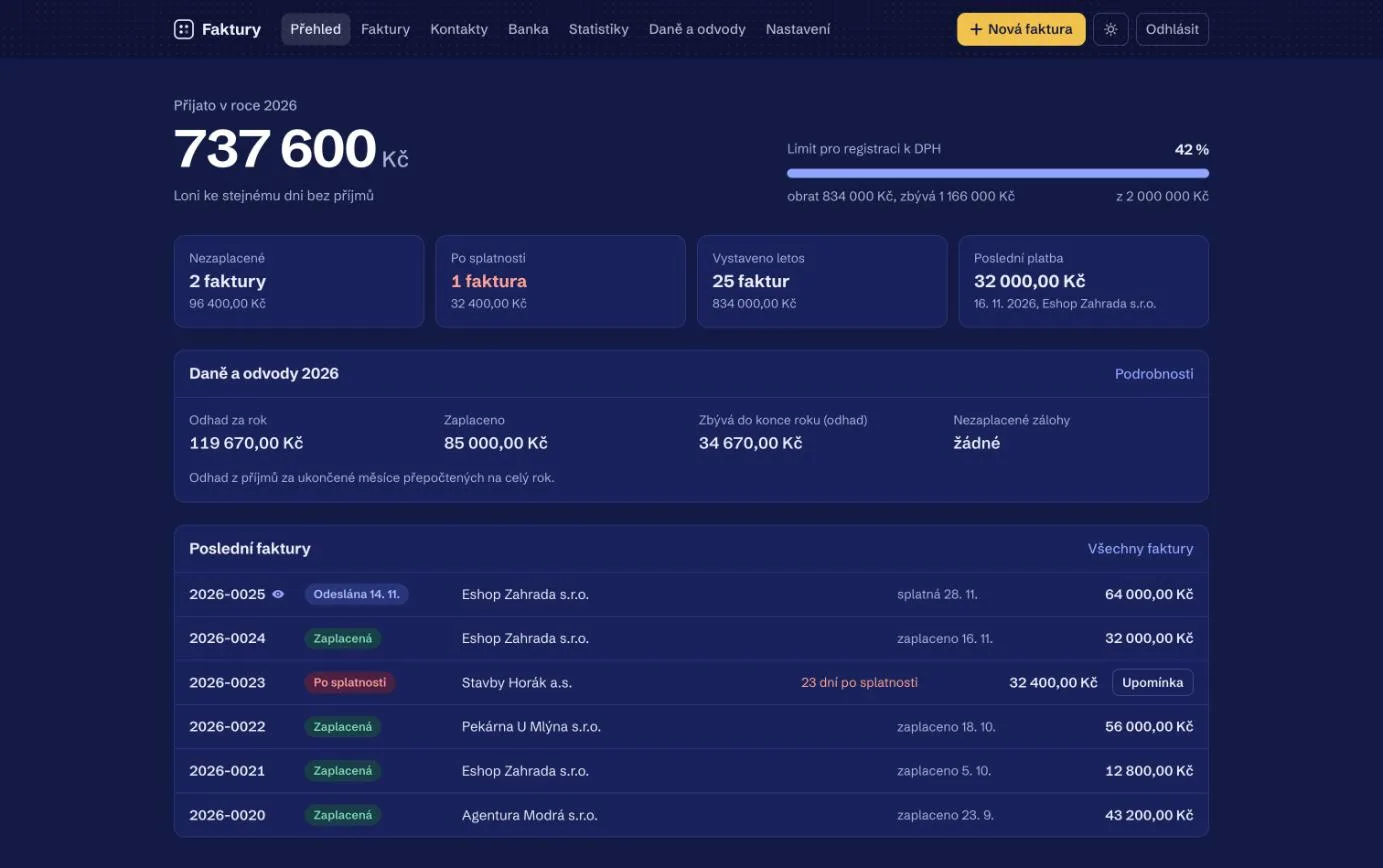
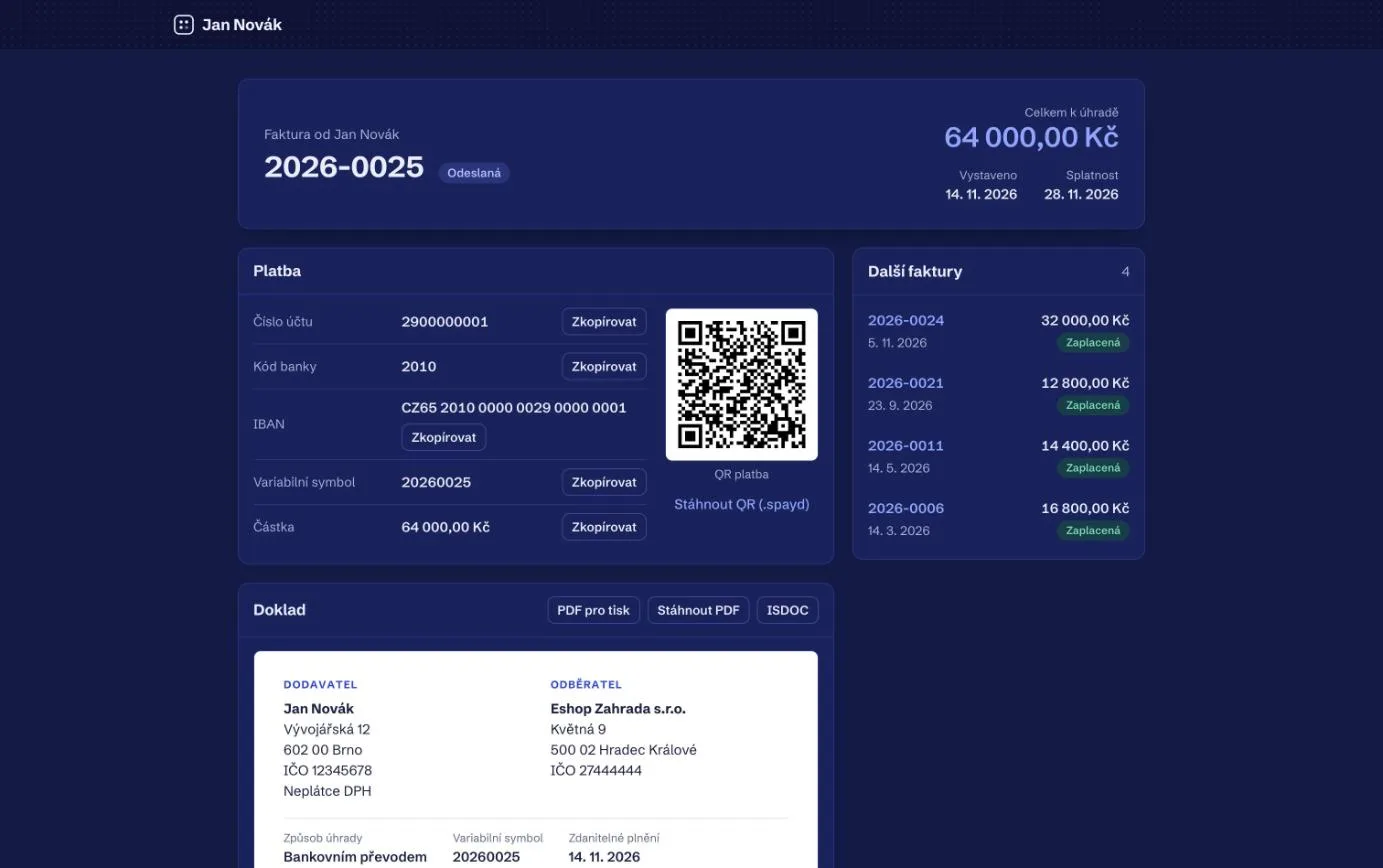
It does everything I used in Fakturoid: invoices with number series and credit notes, PDFs with a QR payment code and ISDOC export, a web view for the client, contacts loaded from the business register, e-mails with reminders, payment matching from the bank, tax and insurance calculations and the documents for filing. The data is mine, and when I need a different report, I brief the agents and have it the next day.
AI didn't make writing code cheaper. It made my attention cheaper, and that was the expensive part all along.
When does it pay to replace SaaS with your own tool today?
The equation used to be simple: development costs hundreds of hours, a subscription costs a few dollars a month, so you pay. For simple tools, the development side has now dropped by an order of magnitude. Replacing everything still doesn't pay, but running the numbers again does. I look at five things:
- How the price grows. A single-user tool for a few dollars a month is hard to justify replacing. A tool billed for every person on the team becomes a better candidate with every new hire.
- How complex the domain is. Agents build a form over a database with a few reports quickly. A system that carries legislation, payments or security needs more attention and more testing.
- How many features you actually use. If you use a tenth of a big tool, you only build that tenth.
- Whether you need integrations. Data you want to connect to your own systems or AI agents is easier to work with when you own it.
- Who will run it. Server, backups, updates and fixes when something breaks. Without that, no saving holds up.
| Tool | Pricing | Replacement effort | Worth replacing? |
|---|---|---|---|
| Invoicing (Fakturoid) | flat fee, often a single user | medium, tracks legislation | only if you already run infrastructure |
| Time tracking (Toggl) | per user | low | for a team, often yes |
| Tickets and projects (Jira) | per user, plus add-ons | medium, you also replace team habits | with agents, more and more often yes |
Invoicing
Oddly enough, the worst candidate of the three, even though it's where I started. It is usually paid by one person, the price is low and the subscription also covers keeping up with changes in the law. It worked out for me because I already have the infrastructure to run it and the development cost dropped to a few hours. A freelancer without that setup should stay with an off-the-shelf tool.
Time tracking
This is where it works out best. The domain is simple (who, on what, for how long), there is no legislation involved and you pay for every user. At IDEATECH we pay for Toggl for about ten people, for something agents build in a few days. That's why we are replacing it now. We also want tracked time connected to invoicing and projects, and with our own tool that is a single database query.
Jira and ticketing systems
I used to say replacing Jira made no sense. Now we are replacing it at our company too. Together with Toggl, with about ten users, it saves us decent money every year, far more than my invoicing. A ticketing system is, at its core, tasks, statuses, comments, attachments and notifications, and agents build that quickly. Meanwhile the per-user price grows with every colleague, and most teams use a fraction of what Jira offers. You can also design your own system so that agents work with it directly: create a ticket from a client's e-mail, add context from the code, or pick up a task and send it for review. The same goes for a helpdesk, an internal CRM or job tracking.
The one thing agents can't build is people's habits. A team that spends all day in Jira will feel the switch. I would start with one team or one type of work and move the rest once the system proves itself.
What else pays to replace today?
You can run most of the tools companies pay for monthly through the same lens. In the B2B world I would look at these first:
- Booking and scheduling (Calendly, Reservio). Free slots, a confirmation e-mail and a calendar connection. Priced per user, with a small domain.
- Forms and surveys (Typeform, Jotform). Almost trivial for a developer, and the answers land straight in your own database instead of yet another service.
- Simple CRM (Pipedrive and similar). Small companies use contacts, deals and reminders. Your own CRM also connects easily to invoicing and tickets.
- Automation (Zapier, Make). Priced by the number of tasks, so the cost grows with volume. Agents write the integration directly, without a middleman.
- Leave and attendance tracking, an internal wiki or a status page. A few tables, simple rules and a subscription for every user.
It's not just companies. To-do, habit or personal budget apps (Todoist, YNAB) are a typical example of personal software that someone working with an agent can now build exactly to their liking. It isn't for most people yet, but anyone who works with agents will try it sooner or later.
And then there are tools I wouldn't replace, even if it took an afternoon:
- Password managers and e-signatures. Security and legal weight, mistakes are expensive.
- Bulk e-mail sending (Mailchimp and similar). You can write a newsletter sign-up form in minutes, but not deliverability and the reputation of sending servers.
- Accounting software. Legislation changes and your accountant has to be able to work with it.
- Slack and team chat. You pay for everyone else being there, and you can't code that.
Do simple SaaS tools have a future?
I think nothing changes for most of their customers. Not everyone wants to run their own app on their own server to save a little money, deal with backups and updates, and keep up with changes in the law. That goes for plenty of developers too, not just freelancers. They pay so that someone else does it for them, and AI doesn't change that. Code was always the cheaper part. The expensive part is operations, support, legislation and the trust that an invoice will go out correctly five years from now.
The pressure will come from three directions, though. The first is people like me: technical customers who build a tool tailored to themselves. There aren't many of them, but they are often the most demanding ones. The second is stronger: when building a clone of a simple SaaS costs a fraction of what it used to, more of them will appear and prices will fall. A tool whose only advantage is a comfortable interface over a table will struggle to justify a per-user subscription.
The third change is less visible. The more work AI agents do, the more it matters whether they can reach a tool. A SaaS you can only use by clicking in a browser will gradually become a worse choice than a system with a good API, even if its interface is nicer.
My bet: simple SaaS tools will survive, but with lower margins. The ones that carry responsibility for the customer (legislation, accounting, data security) and open up to agents will hold on. Per-user tools with a simple domain will lose the most, because that is where customers will be quickest to find that the numbers work.
Why I am building a SaaS myself
So I don't come across as someone who writes SaaS off: at IdeaWood we are building one right now, and there it makes sense to me. IS WoodSoft is a system for the timber trade and Sysel is a mobile app for measuring timber in the forest. I ran them through the same criteria as Jira or Toggl, and the answer comes out the other way.
- The customers aren't developers. A forester or a timber trader won't build their own system with agents and doesn't want to run a server. They pay for someone else to do it.
- It carries responsibility for legislation. WoodSoft files reports under the EU deforestation regulation (EUDR) straight into the EU TRACES system, and Sysel calculates volume according to the Czech standard ČSN 48 0009. Nobody wants to keep track of that on their own.
- The domain is hard. Offline work with synchronisation, voice input, reading forest management plans onto a map. You can't build a clone of that over a weekend.
- One piece of work for many companies. The system was built for many companies from the start, and each one sees only its own data. The development cost is shared by all of them, which is exactly why SaaS makes sense.
It is the same reasoning, just from the other side. A SaaS that carries responsibility for the customer and handles a hard domain has a future. A SaaS that is just a form over a table, billed per user, is something more and more companies will now build themselves.
Want to replace SaaS with your own tool?